An exploration of leather, texture and craftsmanship at Lance Woven Leather.
While working in the USA, I took the opportunity to visit Lance Woven Leather with Nick Napolitano from Article London at their Connecticut studio — a fascinating insight into a company pushing the boundaries of traditional leathercraft.
What makes Lance’s work so special is the extraordinary variety of textures, patterns and colours achieved through woven leather. From beautifully restrained natural finishes to intricate geometric designs, each surface has its own character.
At Ed Tanner, we’ve recently worked with Lance’s woven leathers on bespoke handrails here in the UK, bringing together their exceptional materials and our approach to architectural leatherwork.
Lance kindly provided a collection of samples to explore back at our London workshop. The possibilities are exciting, particularly the way these intricate weaves can be adapted to curved surfaces and architectural details.
It’s always a pleasure to meet people who share our enthusiasm for materials and making.
Next stop: sampling a new woven leather handrail.
With thanks to Anne & Stefano at Lance Woven Leather for their hospitality and beautiful samples.
As if one workshop of my own weren’t enough, I often find myself stepping through the dust and noise of others — wandering factory floors, poring over details with those who, like me, speak the language of making. In truth, a ten-minute conversation in a workshop is worth a thousand emails. There’s an old saying that rings true: It’s good to put a face to a name. I’d go further — it’s better to hear the whirr of the machines, smell the steel, and see the sparks fly.
So, in this first chapter of a new workshop series, I headed to the industrial heart of Birmingham to visit D. Wilson Architectural Metalworkers, a team behind some of the most extraordinary feats of metal engineering. Hidden behind unassuming doors, their work is colossal in both scale and ingenuity — the kind of place where a Boeing 737 might feel at home.
Inside, the air buzzes with purpose. Massive fishbone-like frames of steel are rolled, welded, and assembled into skeletal giants. These aren’t just components — they’re the limbs of a larger architectural creature, destined to become something iconic. It felt like walking through a quieter, steel-bound version of Ted Hughes’ Iron Man — less Marvel blockbuster, more poetic monument.
Among the smoke and steel, I watched a cheerful forklift driver weave between workstations, balancing a load that defied logic. He gave a nod, knowing full well there’d be no hearing each other over the Sabbath-like roar of machinery. Above, a yellow gantry crane floated across the ceiling like a mechanical sunbeam, orchestrating the ballet of production below.
But I was here on a mission: to collect timber samples for a staircase bound for a landmark HQ project in London. The materials themselves might seem familiar — timber, stone, metal — but here, the detail does the heavy lifting. The staircase’s bold metal structure, for all its presence, will be cloaked beneath honed sandstone, a sculpted skin hiding the engineering muscle.
And nestled into that stone — small, precise notches: clues to the craftsmanship at work. From these, hand-shaped rail brackets will emerge, supporting a sweeping timber handrail. That rail, in turn, will be wrapped in the client’s signature black leather — tactile, timeless, tailored.
It’s always a privilege to be part of a build where the hidden work is as beautiful as what’s eventually seen. Behind every project is a network of craftspeople, fabricators, and thinkers who care deeply about what they make — even the parts that are never seen by the public eye.
This visit was a reminder that making isn’t just about end results — it’s about process, collaboration, and, sometimes, standing in the middle of a factory floor just to feel the hum of something extraordinary being built.
Image courtesy of D . Wilson
Post
An Ode to Durkopp Adler 267
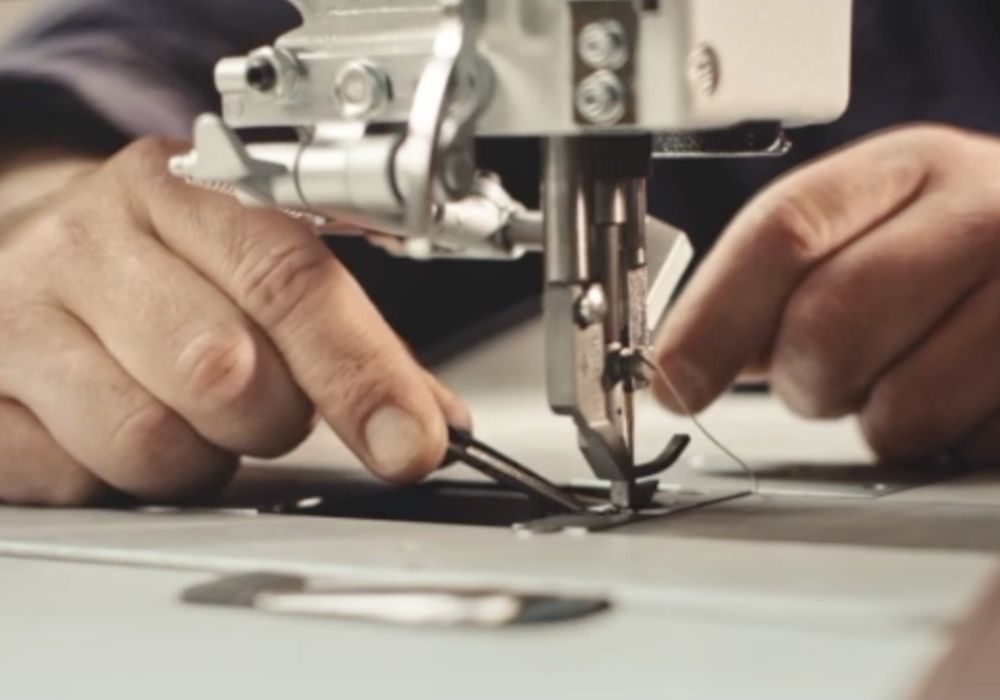
I bought my first Durkopp Adler machine in 2014. I’d had a few secondhand machines by other manufacturers but the Adler was the go-to for everyone I’d spoken to; so when it came to replacing a machine this was my first choice at the time…and it didn’t let my expectations down. It’s a machine that I spend most of my time at in the workshop.
From Frustration to Flow
Before the the Adler I owned many other sewing machines. Using them was like driving your first well-used car that’s passed through several hands: it was exciting at first but each one had its own peculiarities, needing a little tweaking here or requiring a timely nudge there. Learning their nuances was a process of trial and error and while it was exciting at first, it often became frustrating.
From the first threading of the machine, through the puzzling plethora of tensioners and arms, it felt like driving a precision-engineered vehicle. There’s a sense of flow that comes with using a machine like this, where everything just works as it should. It’s not about brute force or flashy features; it’s about reliability and consistency. And when you’re in the middle of a project, that’s exactly what you need.
The Heart of the Workshop
Much of what we do in the workshop is deeply intuitive. There’s a rhythm to the work, a connection between the tools, the materials, and the craftsman. You can hear it in the hum of a well-oiled machine or the hiss of a razorsharp blade parting the fibres of the leather.
More than a Machine
There’s a sixth sense that comes from us working with materials, tools and machines. They become an extension of our hands . The Adler with its un-assuming industrial colours and build slips into this framework. Without any pomp it effortlessly purrs through the trickiest of leathers. It is always there, solid and reliable, it may actually be my best friend! We make great things together. What more could you want!
Post
Spring projects, green shoots
As the first hints of warmer weather peek through, so too does that irresistible urge—to tidy, tweak, tune-up, and generally give the workshop a good spruce. There’s something about spring that makes even the dustiest corners cry out for a little love.
Top of the to-do list recently? Replacing the blade on our ever-faithful splitting machine. For those unfamiliar, imagine a bandsaw turned on its side, without teeth, designed to shave down leather with precision. This unassuming hero of the workshop had been running on the same blade for over a decade—which is impressive considering the machine itself hails from a completely different era.
Meet the Camog C300: a hulking green steel beast of a machine, built in Italy and discovered by us years ago through the magical grapevine of workshop gossip. No manual, of course. So, after some enthusiastic Googling and a few multilingual favours called in, we managed to track down the original manufacturer.
They were wonderfully helpful… until we asked about a mysterious, unlabelled black dial on the front panel. After a pause and some internal factory inquiries, we got a call back weeks later: “The black dial? We have no idea. Everyone who designed and built the machine has sadly passed on.” A sobering moment, but also a reminder of how enduring great craftsmanship can be. Even without a user manual (or dial instructions), the Camog lives on—solid, reliable, and still doing its job with stoic grace 70+ years later.
Thanks to Cutting-Systems UK, our venerable machine now boasts a fresh blade and a new spring in its step. A fine start to a promising year ahead—and a nod to the timeless charm of well-made tools.
Post
Crafting Heritage
From restoring a cherished bag to rewrapping a design classic or replacing the leather handrails at the British Library, our work starts with understanding the brief — and finishes with lasting craftsmanship.
The Vision Every project begins with a conversation. We source the right leather, test sections for approval, and ensure the material meets both the functional and aesthetic needs of the space or object.
The Process Using original patterns or carefully taking new ones, we replace leather with precision and care. Whether working on a one-off chair or a large-scale architectural element, attention to detail drives every stage of the process.
The Result The outcome is leatherwork that feels resolved, considered, and built to stand the test of time — whether it’s a library handrail serving thousands, an Adnet chair inviting quiet admiration, or a well-travelled bag ready for its next chapter.
Ready to elevate your space with bespoke leatherwork?
Are you ready to elevate your space with bespoke craftsmanship? Contact us today to discuss how we can bring your vision to life.